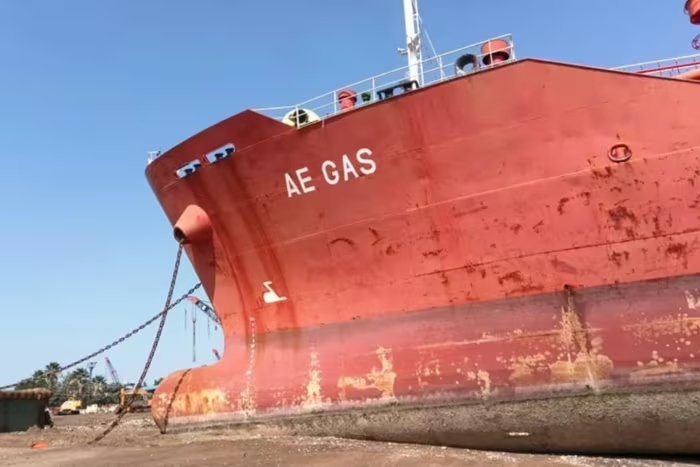
A ship waiting to be dismantled at the Alang yard. Photo: Al Jazeera
Standing on the windy shoreline of the Arabian Sea in the western Indian state of Gujarat, Ramakant Singh gazes toward the empty, endless horizon.
“Back in the day, ships lined up at this yard like cattle before a storm,” the 47-year-old man says. “Now, you can count them on your fingers.”
According to Al Jazeera, Ramakant works at Alang — the world’s largest ship-breaking yard, located in Bhavnagar district in Gujarat, the home state of Prime Minister Narendra Modi. Over the past two decades, Ramakant has dismantled large vessels such as oil tankers and cargo ships from Europe and other Asian countries to earn a living.
With its unique tidal patterns and gently sloping beaches, Alang became the backbone of India’s ship-recycling industry in the 1980s, where vessels could be beached and dismantled at minimal cost.
Over the past several decades, more than 8,600 ships — with a combined tonnage of about 68 million tonnes — have been dismantled here, accounting for nearly 98% of India’s total ship recycling and roughly one-third of global ship recycling.
Across the oceans, a fleet of aging cargo ships, cruise liners and oil tankers is approaching the end of its life cycle. Of the approximately 109,000 vessels still in operation, nearly half are more than 15 years old, and these rusting giants will soon be retired.
Each year, nearly 1,800 ships are declared unfit for operation and sold for recycling. Owners sell these vessels to international intermediaries operating across global shipping hubs such as Dubai, Singapore and Hong Kong. In turn, these brokers sell the ships to dismantling yards in South Asia, where the final stage of a ship’s life takes place.
In Alang, ships are beached during high tide. Hundreds of workers cut them into pieces, salvaging steel, pipes and machinery. Almost everything — from cables to cabinets — is resold for use in construction and manufacturing.
However, over the past decade, the number of ships arriving at Alang’s shores has steadily declined. Once a skyline of massive hulls resembling high-rise buildings towering above the asbestos-roofed houses of the town, today only a handful of cruise ships and cargo vessels dot the horizon.

From cables to cabinets, most materials from decommissioned ships are recovered and reused for the construction and manufacturing markets. Photo: Al Jazeera
When old ships refuse to retire
According to data from the Indian Ship Recycling Industries Association, the 2011–2012 financial year marked Alang’s busiest period since it began operations in 1983, with a record 415 ships dismantled. Since then, the yard has faced a sharp decline — of the 153 plots developed along the 10-kilometre coastline, only about 20 remain operational, and even those are running at just around 25% capacity.
“But what’s happening in Alang has multiple causes,” says Haresh Parmar, Secretary of the Indian Ship Recycling Industries Association. “Most importantly, shipowners worldwide are not retiring their old vessels. After the COVID-19 pandemic, a surge in demand led to record profits in the shipping industry. With freight rates soaring, shipowners are extending the operational life of their vessels instead of sending them for dismantling.”
A major factor behind the spike in freight rates is global disruption. Israel’s war in Gaza has triggered a domino effect across global trade routes, with Yemen’s Houthi forces repeatedly attacking commercial vessels in the Red Sea in solidarity with Palestinians. The resulting security crisis has forced ships to bypass the Suez Canal.
Instead, vessels have been rerouted along the much longer route around the Cape of Good Hope, driving up freight costs and slowing the movement of goods worldwide.
Similarly, an analysis by the United Nations Conference on Trade and Development (UNCTAD) conducted in June 2022 found that the Russia–Ukraine conflict and other tensions in the Middle East pushed maritime fuel costs up by more than 60%, increasing operating expenses and causing shipping delays.
Together, these factors have sharply reduced the supply of end-of-life ships heading to Alang. “When shipowners are making good money, they don’t dismantle their ships,” Parmar says. “That’s why our ship-breaking yards are standing empty.”
Scrap shops in Alang. Photo: Al Jazeera
Compliance with international conventions raises costs
But this is not the only reason Alang is struggling.
India’s ship-recycling industry has undergone a significant transformation since the country acceded to the Hong Kong International Convention for the Safe and Environmentally Sound Recycling of Ships (HKC) in November 2019, becoming one of the first major ship-breaking nations to do so. Under the HKC and the Ship Recycling Act of 2019, yards in Alang upgraded infrastructure, installed pollution-control systems, lined hazardous-waste pits, trained workers, and maintained detailed inventories of hazardous materials used on ships.
However, meeting these standards comes at a high cost: each yard has had to invest between USD 560,000 and USD 1.2 million to comply with the regulations, increasing operating costs amid fierce competition from neighboring countries. This has made it difficult for Alang’s ship-breaking yards to offer competitive prices.
“We simply cannot compete with the prices offered by Bangladesh and Pakistan,” Parmar says.

Supporting industries struggle
Alang is not just a ship-breaking yard; it is a vast recycling ecosystem that sustains the surrounding regional economy.
From the coastal town of Trapaj, an 11-kilometre stretch of road is lined with makeshift shops selling the remnants of decommissioned ships. Everything that was once part of life at sea eventually finds its way here: rusted chains, lifeboats, refrigerators, ceramics, martini glasses, treadmills, air-conditioning units and chandeliers.
The ripple effects of Alang’s decline have spread to other industries. Waste is processed by specialized facilities, while recycled steel is supplied to more than 60 induction furnaces and 80 rolling mills about 50 km away in Bhavnagar, where it is converted into rebar, structural steel and other construction materials.
But with fewer ships arriving, the supply of scrap steel has dropped sharply, disrupting operations at furnaces, mills and hundreds of small businesses dependent on maritime transport. More than 200 retail and wholesale shops that were once bustling now face falling sales.
“Gas plants, rolling mills, furnace units, transport companies, drivers — everyone in this supply chain is losing their livelihood,” Parmar says.