In that context, the Civil Aviation Authority of Vietnam (CAAV) emphasized the priority of aviation safety at the 2025 Aviation Safety Review Conference and the 2026 Task Implementation Meeting held on the afternoon of December 11.
Decrease in fleet size, but passenger volume continues to rise
Speaking at the conference, Mr. Uông Việt Dũng, Director of the Civil Aviation Authority of Vietnam, stated that the National Assembly has officially passed the new Civil Aviation Law to replace the 2006 Civil Aviation Law, amended in 2014. The new law includes an entire chapter on aviation safety.
The regulations have also been clarified and assessed in accordance with the safety standards of the International Civil Aviation Organization (ICAO).
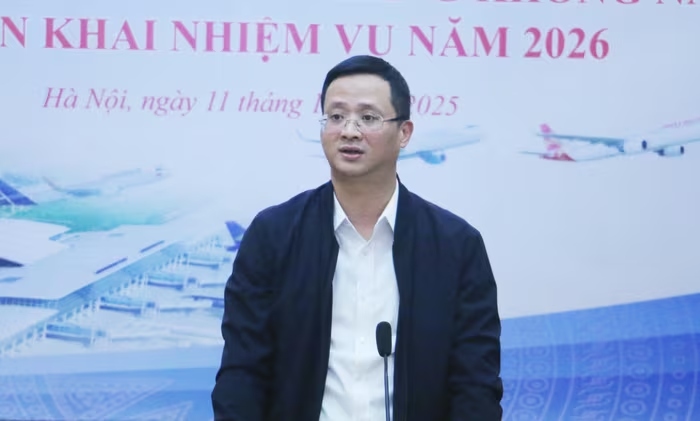
Mr. Uông Việt Dũng, Director of the Civil Aviation Authority of Vietnam.
"This is an important legal framework for issuing and building national aviation safety and security programs, and implementing aviation safety programs," Mr. Dũng said, affirming that in the context of the economy targeting double-digit GDP growth, Vietnam has significant room for aviation development. The aviation industry is forecast to grow around 13–15% in the coming period.
However, to achieve these goals, ensuring aviation safety is critical and must adhere firmly to the principle: “Aviation safety cannot be compromised for any reason.”
Therefore, the CAAV Director requested relevant units to comprehensively assess achieved outcomes, clearly identify limitations, and propose specific solutions and recommendations to improve aviation safety in the coming period.
Units must coordinate with the CAAV to finalize legal documents, strengthen communication, build and promote a safety culture, and utilize digital data to supervise aviation operations, tighten discipline, and improve the working environment.
According to the CAAV report, in 2025, Vietnam’s aviation sector faced difficulties due to a decline in fleet size stemming from shortages of PW (Pratt & Whitney) engines and negative impacts from global political instability and military conflicts.
Notably, on November 28, the European Union Aviation Safety Agency (EASA) issued an emergency airworthiness directive requiring software updates or replacement of the Elevation and Lateral Control Computer (ELAC), affecting 84 out of 167 A320/1 aircraft in Vietnam.
This year also saw multiple periods of storms, fog, and strong convective clouds at key airports, causing temporary disruptions and placing significant pressure on aviation operations.
Despite these challenges, operational activities of Vietnamese airlines continued to grow. In 2025, international passenger volume reached 46.9 million, up 13.3% compared to 2024. Vietnamese airlines carried 19.4 million international passengers, an increase of 5.2% from 2024, accounting for 41.4% of international passenger traffic.
For domestic passengers, Vietnamese airlines transported 36.6 million passengers, up 7.5% year-on-year. Passenger volume increased by 6.7%, and cargo volume rose 4.6% compared to 2024.
International cargo transportation grew 24.6% from 2024, reaching 1.3 million tons. Vietnamese airlines transported 240.2 thousand tons, an increase of 11.2%, accounting for 18.5% of total international air cargo. Domestic cargo volume reached 224 thousand tons, down 1.7%.
In this context, aviation transport activities remained safe and stable, especially during peak travel periods such as the Lunar New Year, summer peak, and major national celebrations like A50 and A80. Safety oversight was implemented strictly across all airports nationwide.
As of December 15, the country had 262 aircraft. Commercial aviation operated 213 aircraft, while general aviation operated 49 aircraft (22 airplanes and 27 helicopters). Notably, 28 aircraft are grounded due to engine shortages (24 A321NEO, 3 A350, 1 A320CEO), accounting for 13.1% of the commercial fleet.
Vietnamese airlines maintain nearly 50 domestic routes connecting Hanoi, Ho Chi Minh City, and 20 airports nationwide. Internationally, there are 113 routes connecting Vietnam to 24 countries and territories worldwide.
.jpg)
Overview of the 2025 Aviation Safety Review Conference and 2026 Task Implementation.
Strengthening discipline and standardizing according to ICAO
Regarding aviation safety, the CAAV reported that through safety surveillance efforts, several existing issues have been identified and require immediate attention.
One of these issues is that aviation personnel have not fully complied with standard operating procedures across various fields. Failure to follow standard procedures has led to situations such as the risk of aircraft-to-aircraft collisions, ground vehicle-to-aircraft collisions, equipment damage during maintenance, and violations of aircraft separation standards.
In addition, adverse weather conditions (thunderstorms, lightning, heavy rain, strong winds) driven by climate change have made meteorological phenomena harder to predict and more abrupt, creating pressure during takeoff and landing phases and reducing runway capacity at many airports. There have also been cases where pilots used recording devices in the cockpit, causing distraction during critical flight phases.
Potential risks from bird strikes are also dangerous, as birds can hit important aircraft components, causing damage (engines, wings, radar dome, etc.). Foreign object debris and animals in the airfield pose collision risks. Additionally, aviation personnel violating alcohol and prohibited substance regulations remain a concern.
On this matter, Lieutenant Colonel Nguyễn Duy Hoan, Deputy Director of the Transportation Security Division (Department of Economic Security), emphasized the aviation industry's core principle: Aviation safety must never be compromised.
Mr. Hoan requested the CAAV to continue reviewing procedures and standards, increase inspections, and strengthen compliance with safety regulations to prevent severe risks.
The representative from the Department of Economic Security also stressed the importance of preventing and strengthening alcohol and banned-substance testing not only for ground service staff but also for flight crew and air traffic controllers.
To further improve aviation safety and meet international standards, Mr. Nguyễn Tuấn Ngọc Tú, Deputy Director of the Transport and Traffic Safety Department (Ministry of Construction), recommended that the CAAV continue completing aviation legislation, finalizing safety regulations, and enhancing safety oversight. He also encouraged risk identification and strengthening the safety management system, particularly promoting a voluntary reporting culture.
"The CAAV needs to strongly apply digital technology in safety management, develop high-quality human resources, standardize departments such as air traffic controllers according to ICAO standards, and enhance inter-agency cooperation," Mr. Tú emphasized.
For airlines, efforts must focus on reviewing and ensuring maintenance and aircraft operation compliance with regulations and safety standards. Airlines should also maintain schedule reliability, foster aviation culture, strictly follow operating procedures, especially during critical flight phases.