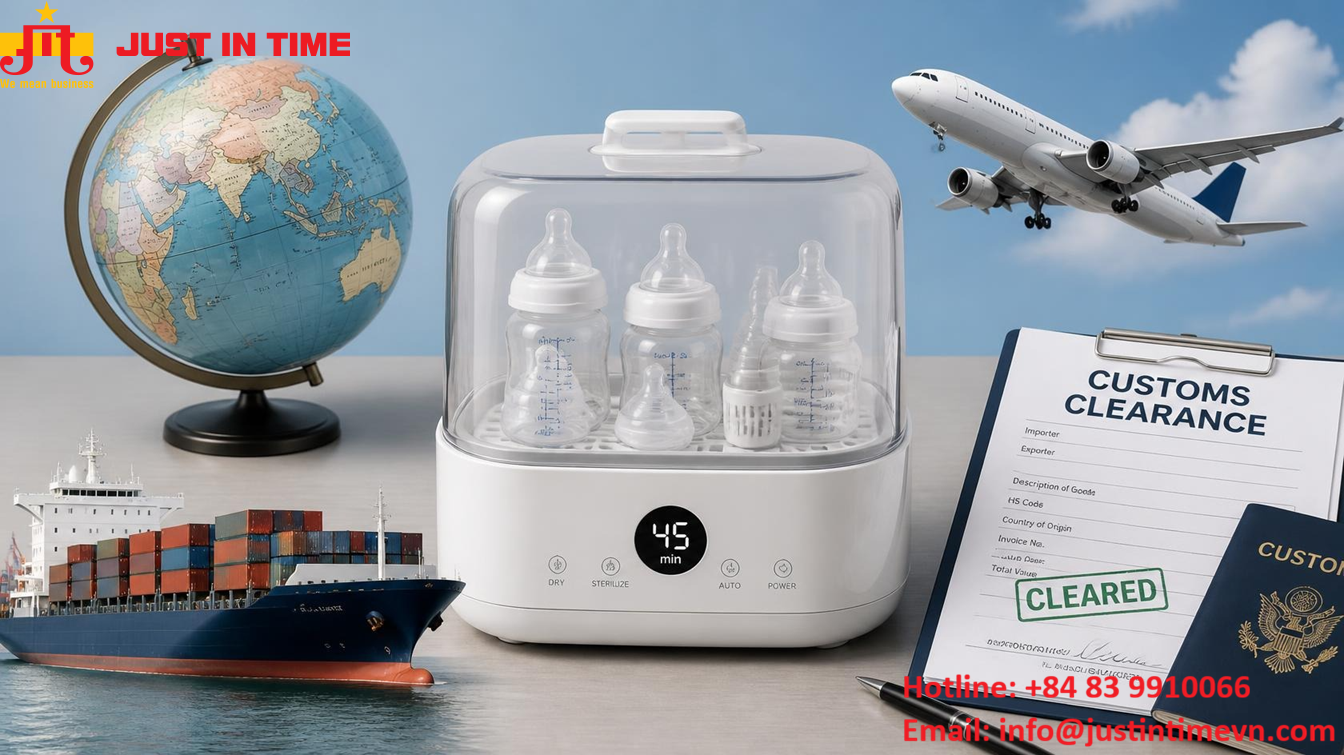
1. Product Overview and Import Policy
Common types of baby bottle sterilizers include:
-
Steam bottle sterilizers
-
Heat sterilizers
-
UV bottle sterilizers
-
Sterilizers with a drying function
-
Sterilizers with a milk-warming function
-
Sterilizers with a storage function
-
Portable baby bottle sterilizers
-
Large-capacity bottle sterilization cabinets
An ordinary household baby bottle sterilizer is generally considered an electrical household appliance. It is not automatically classified as a medical device merely because it has a sterilization function.
However, the applicable policy may differ where the equipment is specifically designed, marketed, and used in hospitals, laboratories, or medical facilities.
Before importing, businesses should check:
-
Sterilization technology
-
Principal function of the product
-
Whether the product is intended for household or medical use
-
Power capacity and chamber capacity
-
Operating temperature
-
UV wavelength, where applicable
-
Drying, warming, or storage functions
-
Electrical safety requirements
-
Product labeling requirements
-
HS classification and tax obligations
2. HS Codes for Baby Bottle Sterilizers
2.1 Steam or Heat Sterilizers
Baby bottle sterilizers that mainly use an electric heating element to boil water, produce steam, or heat the sterilization chamber are generally considered under heading 8516 for electrothermic appliances of a kind used for domestic purposes.
A reference HS code is:
-
8516.79.90: Other electrothermic appliances of a kind used for domestic purposes, other
This code may be considered for:
-
Steam baby bottle sterilizers
-
Heat-based sterilizers
-
Sterilizers with a heat-drying function
-
Machines whose principal function is to generate heat for bottle sterilization
The HS code is provided for reference only. The final classification must be based on the actual construction and principal function of the product.
2.2 UV Baby Bottle Sterilizers
A sterilizer that mainly uses UV lamps, electronic circuits, and a drying fan, without heat being its principal function, may need to be considered under another heading in Chapter 85.
The applicable HS code may depend on:
-
Type of UV radiation
-
Construction of the UV-emitting component
-
Principal function
-
Presence of a heating element
-
Hot-air or fan-only drying function
-
Whether the equipment is specifically designed for medical purposes
HS code 8516.79.90 should not be applied to a UV sterilizer based solely on the commercial name “baby bottle sterilizer.”
2.3 Sterilization Equipment for Medical or Laboratory Use
Specialized sterilizers used in hospitals, clinics, or laboratories may be considered under heading 8419, which covers machinery and equipment used to treat materials through processes involving a change in temperature.
Such professional equipment must be distinguished from ordinary household baby bottle sterilizers.
2.4 How to Determine the Correct HS Code
The correct HS code should be determined based on:
-
Product construction
-
Principal function
-
Sterilization technology
-
Operating principle
-
Power capacity
-
Chamber capacity
-
Operating temperature
-
Steam generation capability
-
UV wavelength
-
Drying function
-
Milk-warming function
-
Intended use
-
Intended users
-
Product catalog
-
Technical documents
-
Instructions for use
-
Product construction diagram
The importer should prepare a detailed catalog describing the operating process, heating element, UV lamp, drying fan, and principal function of the machine.
3. Import Duties and VAT
The taxes that may apply when importing baby bottle sterilizers include:
-
Import duty
-
Value-added tax
The applicable rates depend on:
-
HS code accepted by customs
-
Country of origin
-
Tariff schedule effective on the customs declaration date
-
Certificate or proof of origin
-
Eligibility for special preferential tariff treatment
Where the goods originate from a country or territory that has a free trade agreement with Vietnam, a special preferential import duty rate may apply if the applicable rules of origin are satisfied and valid origin documentation is available.
Common certificates or proofs of origin may include:
-
C/O Form E
-
C/O Form D
-
C/O Form AK
-
C/O Form AJ
-
C/O Form VJ
-
C/O Form VK
-
CPTPP C/O
-
EVFTA proof of origin
-
RCEP C/O
VAT should be determined according to the HS code and tax regulations effective when the customs declaration is registered. Importers should not automatically apply the tax rate used for previous shipments.
Reference tax calculation formulas:
Import duty = Customs value × Import duty rate
VAT = (Customs value + Import duty) × VAT rate
** See more Egg Beaters Import Procedures
4. Import Documentation
The standard customs documentation normally includes:
-
Customs declaration
-
Commercial Invoice
-
Packing List
-
Sales Contract
-
Bill of Lading or Air Waybill
-
Certificate of Origin, if available
-
Product catalog
-
Technical documents
-
Instructions for use
Depending on the product’s specifications, the importer should also prepare:
-
Photographs of the original product label
-
Product construction diagram
-
Description of the operating principle
-
Heating element specifications
-
UV lamp specifications
-
Documents describing materials used in the bottle-contact area
-
Electrical safety reports or certificates, if available
-
Manufacturer’s quality inspection documents
-
Proposed Vietnamese supplementary label
Information across the documents should be consistent regarding:
-
Product name
-
Model
-
Brand
-
Manufacturer
-
Country of manufacture
-
Power capacity
-
Voltage
-
Frequency
-
Chamber capacity
-
Sterilization technology
-
Included accessories
5. Baby Bottle Sterilizer Import Process
Step 1: Determine the Sterilization Technology and Principal Function
The importer should determine whether the machine operates by steam, heat, UV radiation, or combined technologies.
For a multifunctional machine, the principal function should be identified as sterilization, drying, milk warming, or storage.
Step 2: Review the Import Policy
The importer should determine whether the product is an ordinary household electrical appliance or specialized equipment used in a hospital, medical facility, or laboratory.
Step 3: Determine the HS Code
The HS code should be selected based on the product’s construction, operating principle, sterilization technology, heating element, UV lamp, and technical documentation.
Step 4: Check Import Duties and C/O
The importer should verify the applicable import duty, VAT, and eligibility for special preferential tariff treatment based on the country of origin.
Step 5: Check the Product Label
The supplier should provide clear photographs of the original product label before shipment.
The label should show:
-
Product name
-
Model
-
Manufacturer
-
Country of origin
-
Power capacity
-
Voltage
-
Frequency
Step 6: Prepare the Import Documents
The importer should verify the consistency of the Commercial Invoice, Packing List, transport document, C/O, product catalog, technical documents, and product label.
Step 7: Submit the Customs Declaration
The customs declaration is submitted through the VNACCS system. The product description should clearly state the sterilization technology, function, model, power, voltage, manufacturer, and origin.
A reference description for a steam sterilizer may be:
“Household electric steam baby bottle sterilizer, model…, chamber capacity…, power…, voltage…, brand…, manufacturer…, 100% new.”
A reference description for a UV sterilizer may be:
“UV baby bottle sterilizer with drying function…, model…, power…, voltage…, UV wavelength…, brand…, manufacturer…, 100% new.”
The description should be adjusted according to the actual product specifications.
Step 8: Submit Documents and Cooperate with Customs Inspection
Depending on the customs channel, the importer may submit an electronic dossier or cooperate with a physical inspection.
Customs may request additional documents such as:
-
Product catalog
-
Technical documents
-
Product photographs
-
Description of the operating principle
-
UV lamp specifications
-
Heating element specifications
Step 9: Pay Taxes and Complete Customs Clearance
After fulfilling tax obligations and other applicable requirements, the importer may complete customs clearance and collect the goods.
Step 10: Apply a Vietnamese Supplementary Label
Before the product is placed on the Vietnamese market, a Vietnamese supplementary label must be applied if the original label does not contain all mandatory information in Vietnamese.
6. Important Notes When Importing Baby Bottle Sterilizers
Importers should pay attention to the following:
-
Do not determine the HS code based only on the product name
-
Distinguish steam sterilizers from UV sterilizers
-
Identify the principal function of multifunctional machines
-
Check the power capacity and voltage
-
Check the sterilization temperature
-
Check the UV wavelength and lamp lifespan
-
Review the automatic shut-off function
-
Review the safety-lock function
-
Review overheat protection
-
Check the chamber materials
-
Check materials that come into contact with bottles and feeding accessories
-
Avoid using a vague customs description such as “sterilization machine”
-
Determine separate HS codes for accessories imported independently
-
Prepare technical documents before the goods arrive in Vietnam
Common accessories may include:
-
Bottle tray
-
Nipple holder
-
Bottle tongs
-
Water measuring cup
-
Machine lid
-
UV lamp
-
Filter
-
Drying fan
-
Power adapter
-
Power cord
Accessories imported separately may have different HS codes from the complete machine.
Labeling Requirements
The product label should include:
-
Product name
-
Brand
-
Model
-
Manufacturer
-
Manufacturer’s address
-
Country of origin
-
Power capacity
-
Voltage
-
Frequency
-
Chamber capacity
-
Sterilization technology
-
UV wavelength, where applicable
-
Operating temperature, where applicable
-
Sterilization duration
-
Safety warnings
-
Storage instructions
The Vietnamese supplementary label should provide the name and address of the entity responsible for the product in Vietnam, instructions for use, safety warnings, and other mandatory information not already presented in Vietnamese on the original label.
Energy Labeling
Baby bottle sterilizers are generally not listed as a separate product group under the commonly applied mandatory energy-labeling categories.
However, importers should review the policy again where the product integrates the principal function of another appliance that may be subject to energy efficiency or energy-labeling requirements.
** See more Nut Milk Maker Import Procedures
7. Baby Bottle Sterilizer Import Services
A customs and logistics service provider may support importers with:
-
Import policy review
-
Analysis of the product’s technology and principal function
-
Reference HS code consultation
-
Import duty and VAT review
-
C/O verification
-
Review of the Commercial Invoice and Packing List
-
Product catalog review
-
Technical document review
-
Product label review
-
Preparation of customs documentation
-
Customs declaration
-
Coordination of physical inspection
-
Customs clearance
-
Delivery to the importer’s warehouse
Reviewing the HS code and technical documentation before placing the order can reduce disputes regarding the sterilization technology and principal function during customs clearance.
8. FAQ – Frequently Asked Questions
8.1 Is an Import License Required for Baby Bottle Sterilizers?
An ordinary household baby bottle sterilizer generally does not require a separate import license. However, specialized equipment intended for medical or laboratory use should be reviewed separately.
8.2 Is a Baby Bottle Sterilizer Considered a Medical Device?
Not every baby bottle sterilizer is a medical device. Products intended for household use are generally considered household electrical appliances. Specialized hospital equipment may be subject to a different policy.
8.3 What Is the HS Code for a Baby Bottle Sterilizer?
For a steam or electric heat sterilizer, a reference HS code is:
UV sterilizers and multifunctional machines should be classified according to their construction and principal function.
8.4 What Is the Import Duty on Baby Bottle Sterilizers?
The applicable import duty depends on the HS code, country of origin, and origin documentation effective when the customs declaration is registered.
8.5 Do UV and Steam Sterilizers Use the Same HS Code?
Not necessarily. A steam sterilizer generally operates as an electrothermic appliance, while a UV sterilizer may use a UV-emitting component and electronic circuits as its principal operating system.
8.6 Is a Product Catalog Required?
Yes. A catalog helps customs verify the sterilization technology, principal function, power, temperature, UV wavelength, and HS classification.
8.7 Is a Vietnamese Supplementary Label Required?
Yes. Imported goods must have an original label and must be supplemented with a Vietnamese label before circulation where the original label does not contain all mandatory information in Vietnamese.
9. Conclusion
Baby bottle sterilizer import procedures depend mainly on the product’s technology and principal function. A machine that uses an electric heating element to generate heat or steam may be considered under reference HS code 8516.79.90. UV sterilizers and multifunctional equipment may require consideration under a different heading.
The final HS code must be determined based on the construction, operating principle, power capacity, sterilization technology, principal function, intended use, product catalog, and technical documents of each specific model.
Businesses should review product documentation, labeling, origin documentation, and applicable tax policies before shipment to reduce the risk of incorrect HS classification, missing documents, customs delays, and additional storage charges.
If you have difficulties in customs clearance, you can choose Just In Time as a companion.
Just In Time's staff is always enthusiastic to support you to handle your work quickly and professionally.
JUST IN TIME JOINT STOCK COMPANY
Address: No. 5, Dong Da, Tan Son Hoa Ward, Ho Chi Minh City.
Hotline: +84 83 9910066
Email: info@justintimevn.com
Facebook: https://www.facebook.com/justintimevn
** See more Juicer Import Procedures